On a yahoo list I'm on, someone asked for advice about getting a colt used to a lead rope. Two people responded with thoughts about getting colt used to wearing a lead rope on his halter. I thought the question was asking for help getting him used to being led and otherwise handled with a lead rope. This is what I wrote:
I'd think about having him in an area a bit smaller than the length of your lead rope, so this might mean a large stall or a small paddock with a longggggg lead rope, but be careful you never get fingers and legs tangled in it.
My reasoning for this is so that your colt can learn to come off pressure without you being in a situation where you might feel it necessary to put pressure on him. Imagine you're introducing being led, which requires an understanding how to come off pressure, in a large area and he gets moving faster than you can for any sort of reason, and you end up either dropping the lead and worrying like heck about the outcome, or you end up pulling on his head at a time when he is already worried and moving and doesn't yet understand what that confinement and pressure mean.
Now, forget that image because it's best to have images of success when you're training a horse! In any case, he will learn about coming off pressure very quickly IF he's not frightened in the process.
And start with asking him to move off to one side or the other, not straight ahead. So, let's say you are standing off from his left shoulder or hip and asking him to bring his head and body around to the left. Start taking up some slack in the lead rope and when he shows you the earliest sign that he's thinking, wondering about what is wanted, take a little break. A second or two. Then ask again. He will experiment to see what it is you want of him, to see what is the meaning of the activity in the lead rope and the changes in your body.
Give him credit for experimenting even if his 'answer' isn't right yet. So he puts his head down or to the right -- allow that at first. At some point he'll bring his head to the left and then you take a bigger break from the lesson. Within an amazingly short time, he will know what to do when you start taking the slack out of the lead rope. Soon enough he will rearrange his body by moving his feet so he's stepping toward the left like you originally wanted, for example. It's all a lesson in how to release himself from pressure, and the pressure does not have to be obvious, direct pressure to be effective in communicating with him.
Then do the same process on the right.
I like to keep these sessions very short but repeat them frequently and then build on that. It will be different if the wind is blowing or a stranger is watching or you name it. Once he's really certain about what you are asking, then see about going to a less contained situation but be prepared that the changes may unsettle him. Just so you don't frighten him and undermine his confidence in you that you've been building. At some point scary things will be part of what he understands but I wouldn't start there.
Sounds like a lot of fun -- do enjoy the process. There is so much to learn with a young animal.
Wednesday, January 03, 2007

Tuesday, January 02, 2007
Where has the time gone?
It's a little disconcerting to read '2007' on the calendar. It was surprising to realize I'd not posted anything here in my blog since early December! I relunctantly acknowledge a simple truth -- there is only so much a person can do in any one day.
What have I been doing that keeps me from this joy of writing? Designing and building a new home -- house, barn, and riding facilities. Frankly, it is very difficult for me to maintain some grace during this process when I wait too long between times spent riding and exploring communication with my horses. I was more or less accused of prefering to spend time with the horses more than anything else. That may well be true! Now if only I could release myself from feeling guilty about this!
So, in honor of what keeps me from the here and now with the horses, I will share a few photos of the Home Dream Coming True project. RNB thrives on building the dreams. I thrive on living the dream. We are learning from each other as we intend, and share our different perspectives and priorities, with understanding as the core to building intimacy and allowing individuality.
Most days we keep the vision alive. Some days we suffer in separation and self-protectedness. How I am in relationship with RNB is how I am in relationship with the horses. I develop gratitude for how quickly my defensiveness comes to the surface with RNB. It lurks there anyway inside me, and is more subtle and elusive for the most part when I'm with the horses.
Okay, here are some pictures of the dream coming true. I will go today and take more pictures. I think I miss spending time there like I miss spending time with the horses. It is so peaceful!
Fabric windows and light panels on long side of arena.

View of house through west door of arena.

Snow on rafters of house yet to be enclosed.

Hammerbeam construction.

View from the driveway before garage frame was added.

Sunset view from the future breakfast nook.
Monday, January 01, 2007
Musing after a visit with LL
I talk with her every month or so, but it was extra nice to be there in a room full of compatico horsey folks, hearing her tell stories about her time working for Joe Wolter. Each person will draw out something unique in the course of some conversation, so I get to learn more than I would from our discussions.
I came home a bit sorry that I can't be two places at once, because I am envious of her learning opportunity through this work with Joe! But I wouldn't give up the learning opportunities I have right here at home -- between relationship with RNB and relationships with the six horses we have here, I'm kept rolling along on the learning curve. But oh, doesn't it sound wonderful to dream of riding all day six days a week and having a superb mentor there watching and contributing to your horsemanship refinement!
So, what did I bring home from that visit? A few things, but after an afternoon with three of our horses, I come away with more questions than answers!
One thing that sunk in, was after asking the horse to let go of some strong thoughts, to let the horse travel along on their own steam longer than I had been, so the horse gets the sense that all is OK with the choice they just made. Instead of asking again too soon even though the horse is veering off the line again perhaps in the other direction. Picture me riding down the road and Kacee wants to go back to the barn. She is shaping up for a turn to the right and I pick up the left rein. Sooner or later she reshapes her body and releases the rein pressure (and this could all happen on a slack rein, but there is still pressure there, with meaning to a horse who understands that softer feeling). Then instead of proceeding down the trail -- the line I'm intending us to ride -- she tips to the left and gets ready to follow her thoughts back toward the barn.
In the past, I've then picked up the right rein and repeated what I'd done before. But after listening to LL, I let her go for awhile before asking something else of her. What is "awhile"? Good question, and I can't quantify it, but there is a quality of OKness I started to feel in Kacee after we did this a few times. Actually I should have said 'picture us in the ring' because that is where I was riding yesterday. But same principle -- I asked for her mind to take her body and mine to the fourth post on the far side (for example) and her mind was more interested in taking us over to the section of fencing closest to where her horse buddies were.
The exciting thing is that she started feeling of me, responding to my smaller requests to go here or go there, shorter moments of bracing against my idea, increasing number of times her ears popped forward wondering where I was asking her to go. It was sweet. I have yet to build this outside of the arena but if I continue to pay attention and not get ahead of myself with grandiose plans to go for a trail ride now and just ride her where she is in the moment, we will go for that trail ride. I'm confident about that.
Something else LL talked about that stuck with me was how to stop pulling on the horse. What I heard her say was pick up a rein and if the horse is not responding, come in with the legs to say get yourself rearranged, don't stand there getting ready to pull. I needed to hear this because there are frequent times when I ask something, like a left turn, and not getting a soft response, I will pull the head to the left, wait for the horse to come off the pressure, and release. Yuck. Pulling as a habit for both of us. Yucky feeling in me, yucky feeling in horse. And two yucks do not something nice make!
Anyway... I played around with this on Kacee yesterday because she can lean on the reins. So when I got a delay after asking for a change of mind/direction, I asked her to put some effort into what we were doing, in the prerequisite kind way in order not to fully offend this dear but very opinionated sensitive mare, and it worked! She didn't hang out getting ready to be pulled on, she moved. And in moving, easily shaped her body to keep the slack in the rein. What a nice feeling for both of us.
She also did well yesterday with my asking her for more trotting in the ring than we usually do. I am intent on experimenting with how to have a more disciplined useful horse while keeping the emotions calm and the mind open and eager. So far I've opted for the emotions calm and mind eager even if it meant I never did catch or tack up this mare!
Rusty presented some different things yesterday, and along with Sofia, raised more questions than solutions. He is such a character -- I do enjoy him! But now that I have these lofty ideas that my horses can do more than I've previously tended to ask of them, well, I started to ask more of him. He did not respond with as much energy as I was asking. It was in the ring so I could pretty easily eliminate any big fear issue regarding the rocks along side of the road or the leaves falling from the trees, etc. So I thought about some conversations from the past with LL when she talked about dealing with a lazy horse, a stuck horse differently from dealing with a scared horse. I also thought about how Rusty felt to ride after Joe Wolter rode him for a half hour a few years back. I want that feeling again. Think optimally functioning ball bearings, gliding with gusto here, there, anywhere.
And now I think about Harry Whitney talking time and time again about how bad a horse feels when they hold back, when they don't give their all. (True for people, too, eh?) I can hear Harry say that he doesn't like to leave a horse feeling bad, so he does something about it right away. Well, his awareness and skill level are something I might someday walk in the shadow of (forgive the grammar!), but meanwhile, it ties with what I'm feeling from Rusty. Rusty doesn't feel good hanging back with his energy. However, I know he hasn't felt good after he is 100% expressing his energy because there I am, on his back freaking out! (Oh, why didn't I have a grab strap last time I rode a bouncing, bucking, expressive Rusty???)
Deep sigh from me. These pieces are coming together. Rusty is big and expressive at times, and yes if I direct this energy proactively, we do do better than when I let him direct this energy. But meanwhile, when I get scared of what he offers, he gets hesitant to offer it, remembering that not-so-great-feeling coming from me when he did X, Y, or Z. So he will try to avoid doing X, Y, or Z again. Now I'm seeing (I hope!) that this is my job -- to help him feel good about all that energy he has to offer, so he'll offer it and we can do things with pizazz instead of concrete in the feet.
LL talked about this in a different context -- telling about getting the feeling of the horse taking you someplace, compared to the horse going because you are pushing even if it's just a little itsy bitsy gentle barely discernible pushing. Related to what I was just describing, she told of riding a horse out and experimenting with what Joe had told her which was to turn the horse back before the horse felt the need to turn back. But what happened is that the horse started looking to turn back where she had earlier turned the horse back, instead of what she expected which was the horse would want to go further down that road each time.
What she learned from talking this over with Joe, was that the horse was going along feeling great and eager and taking her someplace, and then the horse was stopped from that. So the horse is thinking, I'm not going to go to that place where she stopped all this good feeling, I'll turn away before we get to that place. What LL learned is to do what she did, but then set it up so the horse can take her someplace else, not to ask the horse to take her down a road where she'd ended the lovely adventure.
[Forgive me for any and all misunderstandings and misrepresentations of what LL said and what LL said JW said!]
I realized listening to LL, that I have innumerable times discouraged my horses. Like riding Kacee last week, heading out for a trail ride and she really, really wanted to head up the road toward town. Well, it's a busy paved road with hills and blind corners and little space on the side of the road and I've never ridden there for many reasons and I was thinking NO we aren't going that way, we're going this way as I pulled on a rein to turn her in the direction I wanted to go. Meanwhile I missed feeling that lovely feeling of riding a horse who is eagerly taking me someplace! How much of my decision was due to my fear (fast cars, narrow roadway, etc.) versus simply being stuck on my idea of where to ride?
LL also talked about when a horse is scared, how to help is not to take it physically away from the scary whatever, but take the mind away which can happen as easily as tipping the nose away from the scary thing. If the horse's mind gets away from the scary thing, it is a relief. Indeed, sometimes the feet may have to get away as well, but we don't need to expect that. We can feel when the horse takes a sigh or otherwise shows that it's relaxing. And it builds the horse's confidence in us when we can help it get away from the scary thing.
LL also emphasized (and I may have to get this clear with her again because I'm not fully confident I got this right) that it doesn't matter what is going on outside that appears to scare the horse, what is really going on that is so important for us to recognize is that the horse isn't feeling ok, safe, relaxed, and that worried, scared, anxious feeling condition is the problem, not any particular thing in the environment.
I would benefit from a mind meld with LL right now. Heck, how about a mind meld with Joe Wolter or Harry Whitney? Oh double heck, why would I even want to mind meld with another human to get a clearer understanding of a horse? Silly me! I want a mind meld with each of my horses!
Pictures from my lesson
Thanks to GS, here are some more pictures from my lesson.
RC was very engaging and talkative and right there involved with every moment of the lesson. Willoughby on the other hand, was silent, appeared to be sleeping on the job, but truly was very involved with every moment of the lesson.

I know I wasn't talking about diving but it sure looks like it! I think I was describing the feeling of having to reach forward and use my upper body in order to stand up in the stirrups.

Looking better balanced at posting trot or standing trot than when I was struggling to get my legs back underneath me.

Looking balanced and relaxed with a sitting trot.

Great expression on Willoughby despite what the rider is doing!

Struggling with balance at canter -- note daylight between seat and saddle!

Woohoo! Balancing at canter -- look ma, no hands!

Lesson PS
It was so easy to learn from RC at Photo Finish Farm! It was even easy to take hold of the grab strap on the saddle when my balance was unsettled, and to hear that it was OK to use my arms to hold myself in the saddle when my lower body tension prevented the ease of following the horse's movement. I am going to add these straps to my english saddles -- farewell to pride! And I do want a nice dressage saddle now. One that helps my legs be under me and helps position my hips in a neutral position with ease. I not only rode GS's horse, but rode in her saddle as well -- a Bates Isabell 16.5" dressage saddle. EBay, here I come!
Learning from lesson

I am very pleased I arranged to have a lesson at Photo Finish Farm, and especially grateful for the surprise offer by my friend GS to ride her horse in the lesson.
It was a lunge lesson so control of this lovely fellow was primarily in the hands of RC, as I wanted. I tend to spend most of my energy attending to how the horse is doing, what the horse is thinking and feeling, what the horse might be doing next, and lose track of what my body is doing, so this lunge lesson was time especially for me to focus and learn about my seat and balance.
Wonderful lesson. Yes, I still hurt in some previously underused and slightly shortened/tight muscles, but I was able to come home and practice -- on my lovely but basically undisciplined horses -- some of the positions, motions, and stretching exercises she introduced.
RC helped me get my legs underneath me. Considering I ride in an expensive 'balanced seat' custom western saddle, I was surprised how much effort was required to have my legs well under me, sufficiently to make standing in the stirrups an upward motion instead of leaning forward and upward motion.
She gave me some of the exercises I watched GS do in her lesson before my lesson. Swinging leg back, one at a time, while staying securely connected through the seat bones (opens the hips, increases control of leg activity); standing in stirrups up on toes, then release the ankle joints, then the knee joints, then the hip joints to settle in the saddle again. This is ideally hands free, at walk, then at trot, and I suppose at canter although I didn't try that.
Identifying where the horse's feet are at every foot fall is central to RC's teachings. I'm grateful I've spent time getting that integrated into my every moment of riding, although she helped me with the timing of asking for canter depart.
The biggest 'aha' was using my hip angle to influence the speed of the horse. What she taught worked, which was to be up on my seat bones and tilt them one direction (upper hips back, lower hips forward) for more energy/speed, and tilt them the other direction (upper hips forward, lower hips back) for slow and stop. This is opposite from what I had learned somewhere along the line, and I can recall hearing the instructions "sit back on your pockets" for a stop. What I don't know for sure is how much it becomes what a horse acclimates and adjusts to, versus it is the 'right' way and what I had learned before was 'wrong' and therefore confusing to a horse. I have also heard that a horse will try to get his body centered under the rider, so if I were to tip forward, the horse would be inclined to move forward to get under me. Then I think, if I'm really balanced on the A/P (anterior/posterior) plane, then using the hip tilting is a very small, efficient way to communicate, although the explanation led me to be thinking about energy, not physical balancing.

I think this was my first cantering, before RC helped me understand and feel how I tightened my legs when cantering. It was awesome to feel my legs (hip leg joints) moving with the canter on our next canter. Now at home I can continue to experiment with all of my leg joints moving with the canter motion.

Will remained mentally connected as we prepared to leave.
My experimenting yesterday with my two Morgans led me to think it makes sense to them, however they are both pretty in tune with my intention and my energy output (life up, life down) so I don't know how much they were responding to my hip angle versus my energy and intention. Fun to play with though, and certainly important in my opinion to get control of all those lovely little and big muscles that control my lower torso.
It was a treat to ride a horse who was willing to trot for the majority of a 45 minute lesson! Gave me some motivation to expect more from my horses, and indeed, yesterday's ride provided more 'trot work' in the arena than I usually ask for.
It was a fun challenge to ride a 'lunge lesson' on a horse without someone to lunge us! I approached it with reins knotted safely on the neck, and used them only when a bit of steering would keep us out of trouble. (Picture me on one horse and the other horse free in the arena.) I was more able to practice and experiment with Kacee who offers more life and is more comfortable/willing/trusting? to trot around than Rusty is. I'm still fine tuning my assessment skills regarding Rusty's holding back.
I suspect it's a learned response to my past worry about too much life, so although it's a fear thing (he's afraid because I'm afraid), I think I can address it differently than if he was afraid of crossing a wooden bridge. And I have to constantly monitor MY level of trust with each horse, wishing to really limit -- eventually eliminate -- the hesitancy I add to our rides due to my lingering thoughts about something scary that may have happened last month or last year.
In any case, I look forward to more equitation lessons, and would embrace another opportunity to learn from RC and be accompanied and supported by GS. Something new to look forward to on my next trip(s) to Maine.
Thursday, December 28, 2006
Lesson time
This is a big deal for me. I suspect it will increase my empathy for people who are in the student role with me. I will be in the student role tomorrow, with a new teacher.
I'm fairly comfortable with the teachers/clinicians/coaches already in my life. I see them once or twice a year if I'm able to arrange that (only one still comes within a few hours from here). But tomorrow I will venture to take a lesson not in horsemanship but an equitation lesson. I'm having mixed feelings of course -- excitement and nervousness. I know I will learn new things and I hope I will learn without tears or shame or anguish. Yes, I'm capable of emotional upheaval, although it really has not happened much in the past year or two. At least not in the area of Learning About Horses.
I am grateful for the openness of a horsey friend who blogs prolifically about her lessons and her learning. She has portrayed her instructor in ways that I know I could learn from her, someone with kindness and clarity and a tremendously humungous background with horses and teaching. I have scheduled a lesson with this instructor.
By the way, I confess this will be my first ever lunge line lesson. Something I advocate and teach myself, but have never done it. I expect some interesting revelations!
Sunday, December 10, 2006
Teeth
The equine floater was here the other day. He travels from afar a few times a year and checks and/or works on all of our horses. I like that he is commited to doing teeth without sedation, speculum, or power tools. For the most part my horses like this, too.
I say "for the most part" because for the past few visits, Rusty has not wanted to let the floater do his job. It raises questions and provokes conversation. This visit went much better than last visit. Last time I was ready to say, "Nope, you won't be handling this horse again." I am a protective owner, but sometimes I wonder if I'm over protective, if I expect too little, if I allow too much.
Rusty has been provoking my learning since I got him as a yearling. I'm grateful for the sense (or nonsense) that has led me down this path of horsemanship so that he and I could enjoy our time together. I spent the first few years criticizing him, misunderstanding his needs and his communications, and finally have adjusted my presentation enough so that 96% of our time together is indeed together. What a treat!
So when Rusty was not cooperating with the floater, I got to doubting my approach, wondering if I'd missed something that this horse of mine was so strong in his opinions. Those strong opinons matched with a large healthy body result in situations where either we gain his cooperation, or we don't.
I tried to express this while things were a bit of a mess during the prior visit. I know I used the right words in terms of being clear and understandable, but there might have been an edge to my emotions, because in fact, there was an edge to my emotions. As I watched what was going on I felt increasingly uncomfortable and protective of Rusty. What a bind -- wanting to stop an interaction between a professional and my horse -- risking losing the professional's accessiblity and skill if I seriously turned him off in my effort to protect my horse and facilitate some change so that better communication and cooperation were happening.
Rusty cannot be forced. He has to think about things and make a decision. I know he trusts me enough that ever we had an emergency he would let go of his ideas right away and follow my feel, follow my directions there and then. But on less urgent issues, no force. Period. He knows he is stronger, and he knows from experience that his ways of taking care of himself are likely to be better than those ways of us silly humans.
A vet I used before I moved called Rusty a Prima Donna. Prima Donna has a few meanings: the leading woman soloist in an opera company; a temperamental, conceited person; a disagreeable person, unpleasant person. The vet's comment came after doing the usual annual vet stuff with Rusty, and watching me ask Rusty to stand or move, to lift a foot or whatever. It was not said in a warm loving manner, more with some exasperation that I would have a horse who needed the time he did before he'd 'behave himself'.
And that raises the huge question about horses behaving themselves. How can a horse behave on human terms? Most of what we ask them to do is counter to their very nature. So, in my understanding, am I enabling a disruptive, unruly horse or am I letting him be a horse as long as I'm safe and I enjoy our rides together?
I have to remember that each of us makes choices about our horse handling (excluding those folks who act unconsciously day after day around horses, and sadly there are folks like that), and that my choices reflect who I am today and my history with life in general not only with horses. My reactions around horses are similar to my reactions around people. My best communication offerings around horses are similar to my best around people. I am one and the same person regardless of what species I'm with.
Although, as so many of us know, it is often easier to be in the presence of horse or dog or cat, than of a fellow human being. Sad but true.
I wander in my writing this evening. I started out thinking I'd share about how well little Bo did with the floater. He was awesome! He questioned what this stranger wanted to do but allowed him and was more relaxed at the end than at the start. It was comforting to learn that his teeth were in pretty good shape as I have few details about his past.
I'm a type of person who questions a lot. So now I question -- how come Bo was so good (there's that judgmental word!) and Rusty wasn't (more judgment!)? I question if I've done something wrong and wonder if the longer Bo lives with me the better chance he'll be troublesome, too.
But then I remember standing there after the floater decided not to try anymore -- concerned he'd get hurt as Rusty threw his head around -- and put my fingers in Rusty's mouth, from one side, from both sides, reaching back up toward his molars, pulling his lower lip down, stretching the sides of his lips out, and Rusty allowed this except for one complaint. So that tells me I really can't do anything myself to prepare him any better to accept the floater, unless I asked everyone who comes to the farm to put their fingers and metal objects into his mouth? Sigh. I can do that. But I imagine that anyone I enlisted would either offer an acceptable feel to Rusty and be successful as I was, or offer an unacceptable feel and be rejected as clearly and quickly as a moving equine head can express.
It comes back to the word feel. And what we do when a horse accepts or rejects the feel we offer. Unless it's an emergency, I'm commited to letting the horse say no to me, and then looking for how I can share my intent and gain his cooperation without force. Leslie Desmond has told us that unless a horse can say "no", his "yes" will have little meaning. I'd say this applies to people as well. Having the choice to say "yes" implies that it is OK to say "no" as well. And often I've let a horse say "no", waited a bit, and found the horse offering a "yes".
Blah, blah, blah. It was an invigorating day outside in the chilly air but bright sun, warmed by my brandnew sheepskin hat, much more fashionable than my trusty old red and purple gortex hat. I'll have to get a picture of it, or wait and take a picture of my dreams if I make them come true -- dreams of making sheepskin hats from our Jacob sheepskins. I think their long fleece would look good on the outside of a hat, but would it be as warm as when it's on the inside?
Here I go again... blah, blah, blah.
It's in the little things
I spent time with Bo today. I haltered him and checked how he responded to my requests for him to circle around me, change directions, slow down, stop... All this within a few feet of his beloved Sofia, then further away when things went well at that close proximity.
He would have preferred at times to be shooing the other horses away from Sofia. But he let go of those thoughts fairly easily. When I felt like he was comfortably with me, I gave him a job: follow me while I picked up rocks and moved them.
Sometimes I do this with a horse whether there are rocks to be moved or not. Today there were real rocks. Real or imaginary, that doesn't matter as much as my focus and intent on doing something. He stalled out a few times but then understood what his job was, keeping the float in the lead and stopping when I did, and waiting. It's amazing how relaxed a horse can get when he has a job and knows what it is, and especially when he's asked to do something meaningful, not simply asked to move this way or that. Horses prefer to join us when the focus is on something we can do together, not just when we focus on them doing something.
I did find that if my rock-carrying route was off to the right of him, he didn't understand how he could reposition his body to let me do my part of this job. So I helped him get a better understanding of something some might call yielding his front end, or a turn on the hindquarters. It involved helping him think about getting ready, lifting his withers, stepping back and over away from where I needed to walk, giving me the space to pass there. He picked it up pretty quickly. It was sweet.
Then I led him into the barn. I had no plan other than 'take some rocks' into the barn, then we headed out again. Knowing how quickly the white of his eyes comes to view, I was careful all the time to take him deeply into his comfort zone after I took him a little bit toward the outer edge of his comfort zone. So in the barn, turn and out of the barn. Go pick up rocks again and back to the barn. Realizing this would be a good time to check if any of our saddles fit him, I tied him to the high O-ring and got the first saddle I came across. He was a little worried about the saddle and about being separated from Sofia, but Sofia must have known this because she arrived at the barn door and stood there.
That first saddle was too big -- too wide and too low on the withers. The second saddle, another English one, fit better and might do, although he's a pony and the saddle looks big on him. I suspect anything that is going to fit me will look too big for him.
Then I set my nice western saddle (semi custom from David Genadek, www.aboutthehorse.com) on him. Although proportionately it looks big for him like the English saddles did, it fit his back pretty well.
If I keep this handsome pony, I will get a saddle that fits him better. I'm fussy when it comes to saddle fit, regarding both fits -- fit for horse, fit for rider.
Done with that, I untied him and led him back out to the paddock. After I removed his halter, he stood there, 'with' me, until I released him to go. I'm growing fond of this fellow, and I think he's starting to understand the routine here and feel OK about it.
Friday, December 08, 2006
Bo update

The equine floater was here today and Bo was very good for this. Apparently Bo has been done before, has had regular care, and just needed what one would expect a horse to need who hadn't been floated recently. So either he has been done or he's got an amazingly good bite and ability to keep his teeth in good form on his own.
This floater does it without sedative or speculum or power tools, just gets his own hands into the horse's mouth and assesses then uses normal hand tools. Bo questioned this but then settled in for the process. I have the horses done outside so if they need to back up for awhile they can. A horse who is an old hand like our Haflinger can be done inside in a more confined space.
It's interesting to take out hay and see who gets to approach me first. Sometimes it's Bo and Sofia, sometimes it's Rusty and Kacee. I really like the changes with Bo regarding his apparent attacking behavior -- he sometimes still does it when he feels another gelding is too close, but he puts much less effort into it and does it less often. He seems most worried when Sofia wanders off close to the other horses.
Understanding regardless of equipment
I've been thinking about some recent discussions on a yahoo list I'm on (BillsBook@yahoogroups) which is set up as a study group focussed on True Horsemanship Through Feel (THTF) by Bill Dorrance and Leslie Desmond, and on Leslie's new audio book, Horse Handling and Riding Through Feel. The talk has been about bits, and has left me scratching my head some. Finally, in good study group form, I opened THTF to look for some ideas from Bill about what was mulling around inside me.
I quote from the top of Page 95: "A horse that doesn't lead up well when you want him to, isn't going to be reliable to ride. When you cannot control the timing and placement of his feet in response to the feel you present with the lead rope, your intent won't be clear to him through the reins either."
There are other great quotes in the next few pages. This one I choose to focus on because behind the words, I'm given a bigger picture of what I have going for me, or not, that is basic and can be tested from the ground before I ever mount up. (See Page 96: Test Him Out: "No matter what you have on the horse's head, you'll first test him out on certain things to see how much he understands.")
I'm guilty. Guilty of overexposing my horses because in my eagerness to 'go for a ride', I have many, many times tacked up and mounted before adequate understanding was developed between us. It wasn't until my last riding injury that I took this ground preparation with great seriousness. Before that yeah, it was important, but heck, I can ride some wildness and gee, I'll take care of it from his back. Those are some of the less conservative, more thoughtless ideas that permitted some of my riding activities.
Now though, I do want to see signs of some solid understanding before I mount. That I can assess this by leading a horse someplace is so easy it eluded me. Now combine that assessing with some common sense (don't get on before the understanding is established on the ground) and I'm golden.
This ties in with the tack stuff I've been thinking about. I know quite a bit about pressure and release, and at times have been satisfied and confident that I can teach a horse where to find a release. Lately though I'm no longer satisfied with that, and want to teach my horse to follow my intent, my feel, with slack in the lead rope or the reins. This is different from finding his way off pressure. This is more like shining a flashlight to illuminate the route through a fully furnished dark room instead of shuffling along, feeling for the likely bumps into furniture as I make my way in the dark. I'm not sure if I'm expressing this clearly or not.
In any case, when I take the time to establish a clearer understanding about stop and go, and speed and direction, then it hardly matters whether I have a piece of cotton sewing thread in his mouth, or single or double jointed snaffle bit. He will respond to my intent, my line of sight, my body shape changing, the feel of the reins on his neck, but really, if I've done my homework, he would not have to run into the nutcracker on the roof of his mouth or stretching of his lips because he knows what to do and I'm paying attention not to let us get into something that might elicit my relying on applying pressure on the reins/bit/mouth.
Please don't misunderstand, I'm not 'there' all the time with my horses by any means. But the vision of how it can be is clearer and my motivation is stronger than ever, and so far so good.
I'll include one more quote, this time from Page 97: "What I mean by 'leading up real free' is a horse paying attention to the feel of your halter rope, or your reins, and following the feel you present by livening up his whole body. The important part in this is that he's ready to move his feet, and will move them, before the float is ever taken out of the rope. And he'll do this without any confusion, and he won't be trying to take over with ideas of his own. No, it would only be in response to your feel to move that he'll lead up with a float in the rope and look for a place to go."
Now to keep my assessing frame of mind as I go out to feed some hay to the herd.
Sunday, December 03, 2006
Horses calm in proximity

Horses eating hay on a sunny afternoon. From left to right: Rusty, Kacee, Soli, Prince, Bo, Sofia.
RNB and I built three hay cribs last fall in hopes of losing less hay to the snow and mud. In the cold of winter I put a square bale in each box twice day. This time of year most of the horses still are on pasture although they all enjoy some hay once or twice a day. Kacee is off pasture unless muzzled there for short periods due to metabolic issues with the grass.
"Easy keeper" is a misnomer. She is not an easy keeper -- she requires hay all year despite the pastures we have. But it is worth taking care of her -- she's a doll to ride, and I'll be forever grateful for all the learning she has facilitated.
Can you see the two other species in the photo?
I did ride Rusty

Weird picture, eh?
I was riding Rusty and started taking pictures of my riding companion...

I found Rusty on the edge of startlement each time the digital camera made its little electronic clickety beepy sounds. So I took a few shots just to acclimate him to the sound, not attending to focus or content of picture.

Ride was pleasant. 40 degrees, sunny, horses happy enough to head out down the road. Nothing remarkable to report. Which is, in fact, remarkable.

Monday, November 27, 2006
Latest horse delight
When I went out to feed some hay last night, standing there blinking in the brightness of spotlight turned on, were four dark horses facing me, side by side all in a row two yards from the doorway: Sofia, Bo, Kacee, and Rusty. Oh how I wish I had had my camera handy!
Sunday, November 26, 2006
I did not ride Rusty
I love this horse. He is eager to go on adventures 99% of the time. Today was no different when I came out of the barn into the paddock with halter in hand. But no, not today, Rusty.
Why not today? Well, because he has some puffy areas on his back where the saddle would sit -- puffy and bare of hair. Consequences of some interherd dynamics since little Bo joined us. That pony is athletic!
Rusty must grow to about 17 hands when his life is up. Round and levitating and gorgeous. And somehow that little pipsqueek of a pony -- 13 hands or so -- can get his teeth on Rusty's withers at the gallop.
I am so very grateful that nothing more than hide damage has occurred here. Not counting fence damage, that is. But both are repairable, either by me or by Mother Nature. And day by day the horses get more comfortable sharing space. I watch their personal bubbles shrinking.
One day I will be amazed watching Rusty and Bo share a pile of hay. Today I was amazed watching them standing still about three yards apart. It wouldn't be quite accurate if I said "hanging out" because the vibe wasn't quite a hanging out vibe. It had some watchfulness, but no commitment to defensiveness or offensiveness, not even on the edge. Some readiness, yes, of course.
If there is no more teeth contact, I should be riding Rusty again in a few days. I am liberal with tea tree oil, Eclipse wound healing cream, and healing intentions.
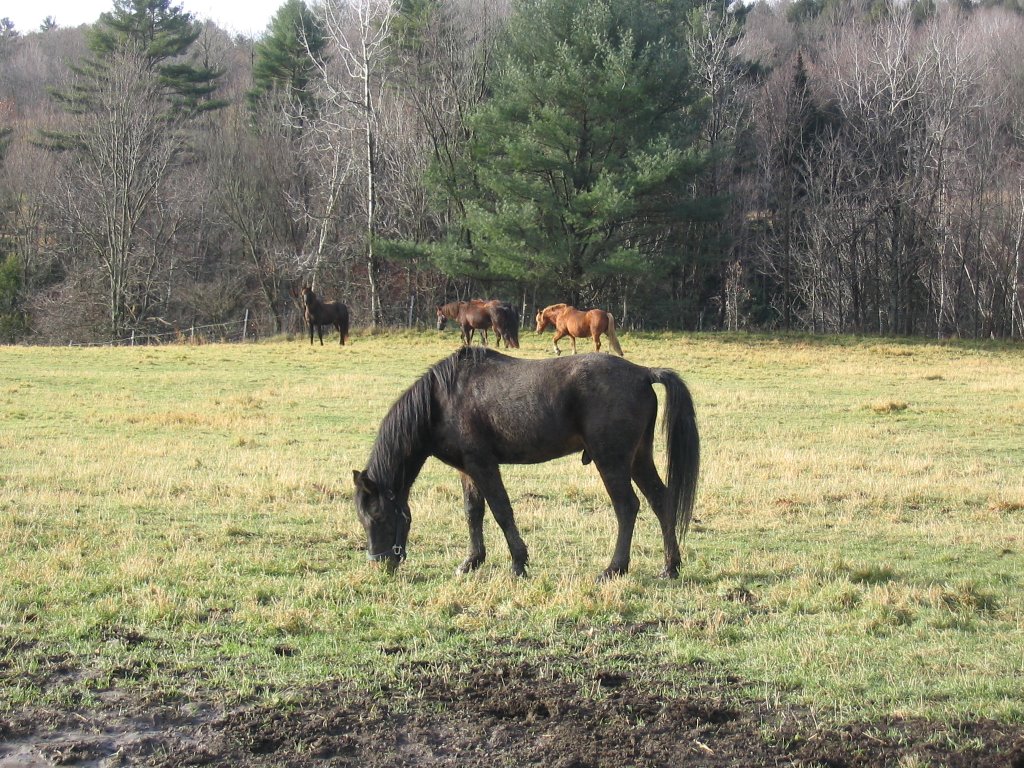
Lively herd...

Quiet herd...
Wednesday, November 22, 2006
End of a teaching day
Teaching therapeutic riding lessons today went well. The team of horses, volunteers, and site staff worked well and creativity infused our time with students. We are still getting used to teaching in the indoor arena, a new arrangement this season.
On the way home, a glorious sunset caught my attention time and time again. I stopped to take pictures and although none do justice to the real thing, here is what I captured on camera.

On the way home, a glorious sunset caught my attention time and time again. I stopped to take pictures and although none do justice to the real thing, here is what I captured on camera.

Sunday, November 19, 2006
Chilly ride
We rode today! Neither cold nor hunting season kept us away from a lively 'trail ride' on the near-by dirt roads. The youngster who has been riding with me for a few months joined RNB and I for this adventure and it was fun. We rode Prince, Rusty, and Soli, and all were forward and responsive and a bit on the edge of lots of life. There were some controlled trots, some intermittently controlled canters, and some full out galloping. The horses needed it as much as we did. They've been spending a lot of time on soft footing (muddy paddock and/or damp pasture) and I know it feels good to stretch out on some firmer footing!
Friday, November 17, 2006
Horses getting along

I love this picture of Bo and Sofia, gazing off in the distance. I've read that being able to see across distances is soothing to a horse. I'm guessing it relates to their self preservation and the need to see what is around them and decide whether to eat, nap, or run depending on what they perceive in their environment.
Progress with building
The arena has two sides covered. We will use trampoline type fabric to cover the remaining openings along the sides. That fabric allows air to circulate while keeping most precipitation outside.

The house has many of the rafters in place. The crew expects to place the rest of them today, including some odd angles with the second timberframe dormer.
Four pictures of one rafter's journey:


We joked about creating a saddle to add a measure of comfort for the men straddling the beams.
Status of building at end of day yesterday.

It poured rain overnight and fields here are flooded. The cows are stuck across the brook which now covers most of the lower two pastures. We'll soon see how the drainage is at the new place.
RNB envisions me trailering over to ride in the arena when it's done. I say, let's see what the roads are like at that point!
With the rain and deer hunting season and the excitement of the timberframe arrival, I have not ridden much in the past few weeks. I am taking the slow approach to expecting much from our new horse, allowing him lots of time to acclimate and settle in the herd. I've already found he has started to look to me and approach me out in the field similar to how the other horses do. He's watching them come to me for closeness, with or without scratches. He's wondering about all this.
Where am I this time?


It's hard to get good pictures in an indoor arena setting without a tripod. I have to turn off the flash option and hold steady. No success getting the photographic subjects to stand still!
Subscribe to:
Posts (Atom)